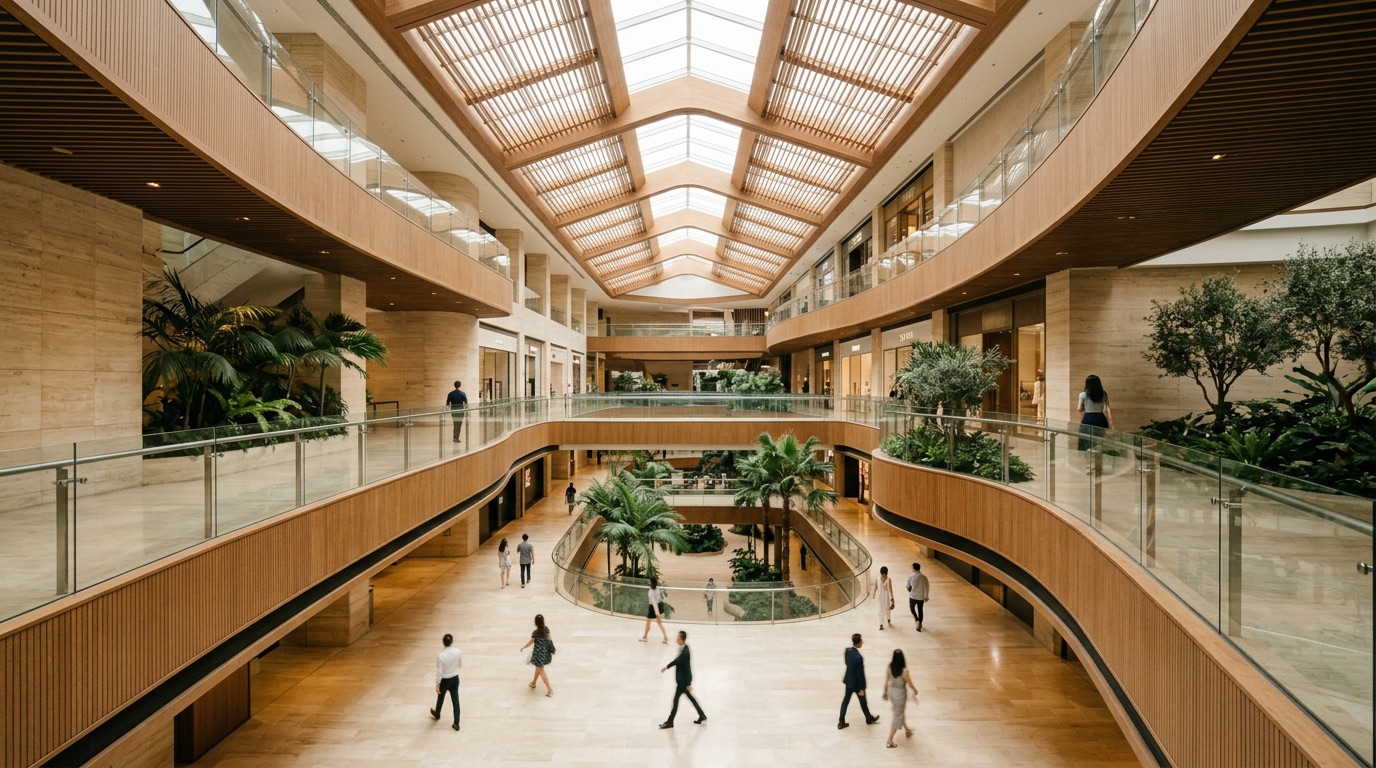
Most of the famous scent research was run in American and European shopping centres. If your building is in Johannesburg, Jakarta or Jeddah, that should give you pause, and then some reassurance, because the newer work from those regions tells a consistent story.
Richard Ndengane, Roger Mason and Misheck Mutize studied store atmospherics across South African retail outlets, in Innovative Marketing, and found what the Western studies found: the physical environment shapes customer satisfaction, and satisfaction shapes how much time and money people give the store. The finding travelled. Culture changes what a pleasant environment feels like. It doesn’t change the fact that the environment is doing the work.
Sadhana Vadhwani and Sanjeev Tandon reached a similar place studying hypermarkets in Noida, on the edge of Delhi. A positive in-store environment, they found, raises the time and money customers are willing to spend. Different market, same lever. For anyone operating across Southeast Asia and the Middle East, that consistency matters more than any single headline number, because it means the underlying principle can be trusted even where the local research is still thin.
But there’s a subtlety in the theory that separates the spaces that get this right from the ones that merely spend on it. It comes from a framework by Francesco Massara and Sandra Liu, who argue that a retail environment doesn’t work in isolation from what the shopper came to do. What matters is congruence between the environment and the consumer’s goal. A space that fits the mindset someone arrived with is easier to process, feels better, and is more likely to shape their choices. A space that fights that mindset creates friction, however handsome it is.
Fit beats finish
That reframes the whole question. The aim isn’t a beautiful environment in the abstract. It’s an environment congruent with why people are there. A grocery run and a leisurely browse are different goals, and the atmospherics, scent included, that serve one can obstruct the other. A fast, functional space drowned in a slow, luxurious fragrance sends a mixed signal. So does a destination space that smells purely utilitarian.
This is where a lot of property and centre-management spend goes slightly wrong. The brief becomes make it feel premium, full stop, without asking premium for whom and for what purpose. A transit hub, a flagship mall and a business hotel all deserve considered environments, but considered means matched to the visitor’s intent, not maximally impressive in a vacuum.
It also explains why copying a competitor’s scent strategy rarely works. Their environment is congruent with their audience’s goals, or it isn’t. Lifting the fragrance without the context is lifting the answer to a different question. What reads as effortless calm in a spa hotel reads as sedation in an exhibition hall where people came to move and meet.
There’s a practical wrinkle the regional operators know that the Western studies rarely mention: climate changes the brief. Heat and humidity alter how a fragrance lifts and lingers, and a formula calibrated for a temperate European mall can turn cloying in a Gulf atrium or thin to nothing in an open, air-conditioned tropical concourse. The principle travels. The formula and its calibration have to be reworked for the actual conditions, which is one more reason borrowed scent strategies tend to underperform.
For decision-makers, the practical test is simple to state and harder to pass. Before specifying anything sensory, be honest about why people come to this space and what state of mind they arrive in. Then design the environment, including its scent, to agree with that state rather than override it. Satisfaction, the research keeps showing, comes from fit.
The environment was never decor. It’s one of the few levers you own that acts on how a place is judged and how long people choose to stay in it. In markets where the research is only now catching up to the West, the operators who understand that early hold the advantage.