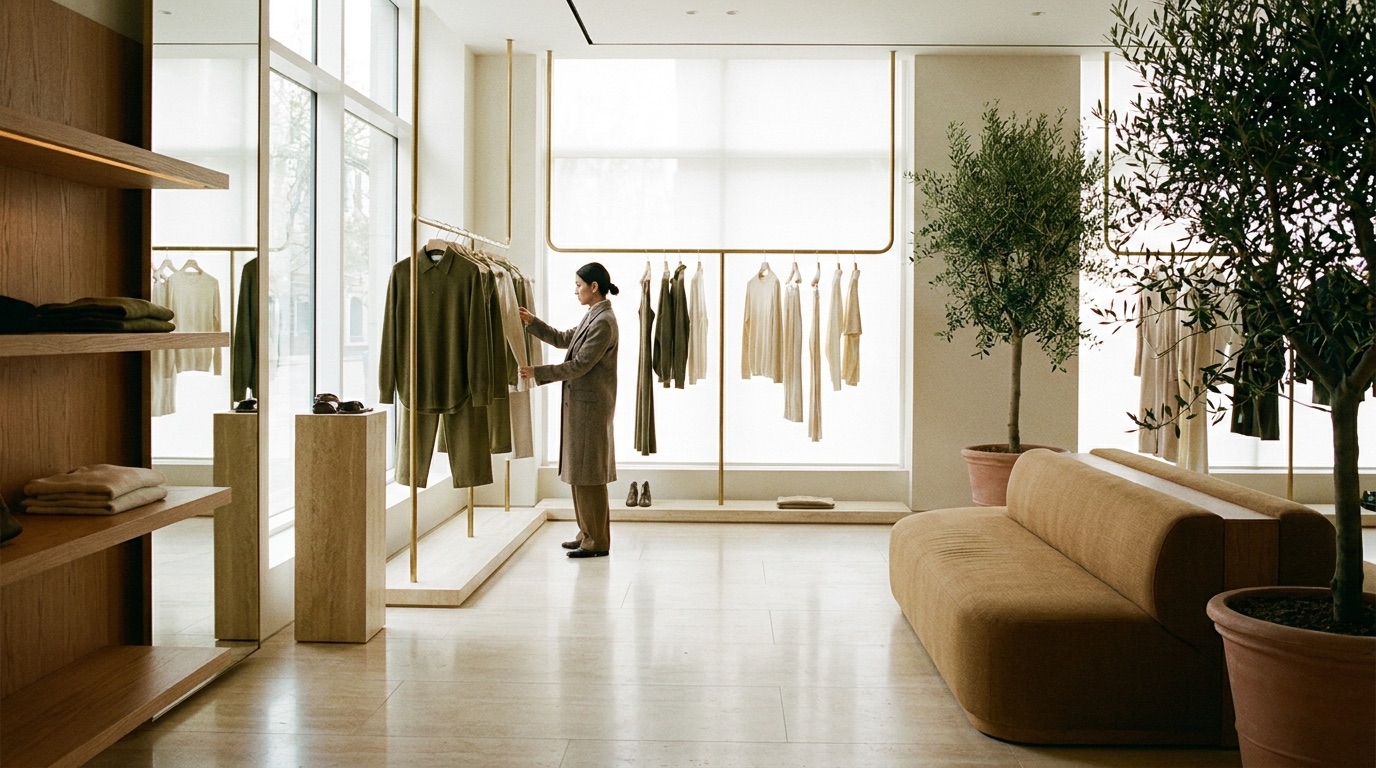
Every environment gets one of two answers from the body before the mind has a view. Stay, or leave. Move in, or move on. Retailers have had the language for this for decades, approach and avoidance, and in high-end spaces it’s close to the whole game. A luxury store isn’t trying to sell you something in the first thirty seconds. It’s trying to get you to stay in the room.
Chantel van Niekerk and R.H. Goldberg looked specifically at this in high-end fashion, in the Mediterranean Journal of Social Sciences, and their framing is the useful one. Scent marketing, they argue, influences whether consumers approach or avoid, and fashion is unusually exposed to it because fashion is emotionally charged to begin with. People aren’t buying utility. They’re buying how the thing makes them feel about themselves, and the environment is doing much of that work before a single garment is touched.
Their research points to scent keeping people browsing for longer, deepening involvement, and making them more comfortable in the space. In a category where dwell time and emotional involvement are the leading indicators of a sale, that’s not a soft benefit. Comfortable people stay. People who stay handle the product, try things on, let themselves imagine owning them. Every one of those is an approach behaviour, and scent is one of the quietest ways to encourage it.
What makes this matter more in luxury than in a supermarket is the margin for error. A discount environment can afford to be a bit generic. A premium one cannot. The whole proposition is that this place is different, considered, worth the price. A space that smells of nothing, or worse, of the same synthetic freshness as the chain store down the road, undercuts that proposition at a level the customer feels but rarely reports. It just seems slightly less special than the price is asking them to believe.
This is where the approach-avoidance lens earns its keep for hotels and members’ clubs as much as fashion floors. The moment someone walks in is the moment they decide, mostly unconsciously, whether to settle or stay on guard. A scent that signals calm, order, and a place that has been thought about tips people towards settling. The absence of one leaves that decision to the lighting and the staff alone, which is a lot to ask of them.
There’s a discipline point hiding here too. Approach behaviour depends on the scent feeling effortless, a property of the place rather than a device aimed at you. The moment a fragrance reads as marketing, as too strong, too obvious, too clearly piped in, it can tip the other way and trigger the very avoidance it was meant to prevent. In premium settings especially, restraint is not timidity. It’s the point. The scent should be noticed the way good tailoring is noticed, which is to say barely, and only by how right it feels.
It reaches past the shop floor, too. The same first-seconds logic governs a hotel arrival, a private bank’s reception, a business lounge. Anywhere the product is partly the feeling of being somewhere considered, scent is working on the approach decision before a guest has spoken to a soul. Leave it blank and you’ve handed one of your strongest first impressions to whatever the air conditioning happens to be carrying that day.
For anyone running a high-end environment, the question worth asking is uncomfortable but clarifying. When someone crosses the threshold, is the space giving them a reason to stay, or leaving that to chance? Van Niekerk’s work suggests scent is one of the few levers that acts in those first unguarded seconds, before the customer has decided who they are in your room.
Get it right and people linger without knowing why. In a business where lingering is the beginning of everything, that isn’t a detail. It’s the strategy, wearing a subtle disguise.